Door Won’t Latch, Swings by Itself, or Rattles? The Hinge and Latch Alignment Guide
By the FaultToFix team | Published: 31 October 2026 | Last updated: 31 October 2026
DIY level: Easy · Cost: £0 for the tests and most adjustments; £4–£12 if a hinge is replaced · Time: 10 minutes to diagnose; 20–45 minutes for most fixes
Quick Answer: A door that won’t latch is almost never a broken latch — it is a door that has moved. The latch bolt lands a few millimetres high or low of the strike plate hole because the door has dropped slightly on its hinges. The latch-mark test (a dab of lipstick or chalk on the bolt) shows exactly where the bolt lands, a hinge-screw check usually finds why it moved, and realigning the door — or nudging the strike plate by the same few millimetres — restores the click. A door that swings by itself has hinges out of plumb, and a rattling door usually has a loose strike plate or worn hinge screws. All three are alignment jobs, not replacement jobs.
Key Takeaways
- Test before you touch: the latch-mark test shows where the bolt actually lands — high, low, or short — and that decides the fix.
- The latch is the messenger, not the fault: doors drop on their hinges, and the latch is simply where the drop shows up.
- Screws before parts: loose or spinning hinge and strike-plate screws explain most latching, rattling, and squeaking faults.
- Lubricate hinges with the right thing: a drop of light machine oil or silicone on the pin — never thick grease, and never spray lubricant into a lock.
- A door that swings by itself is hanging out of plumb: check which way it swings and which hinge is loose before reaching for a doorstop.
- Lock mechanisms are not DIY: a jammed or broken lock, or a key that will not turn, is a locksmith job — do not dismantle it.
Jump to a Section
- Confirm the diagnosis · Symptom → cause table · You need · The latch-mark test, step by step · Fix the alignment · The screw check · Hinge lubrication and squeaks · A door that swings by itself · When a hinge needs replacing · Common mistakes · If that didn’t fix it · When to stop and call a professional · Cost table · US / UK term box · FAQs · Checklist
Safety box
Do not dismantle a lock mechanism — tubular latches, mortice locks, and multipoint locks have springs and parts under tension, a dismantled lock can leave the door unsecured, and a broken mechanism is a locksmith’s job, not a learning opportunity. Do not alter a fire door’s hinges, closer, or latch in any way; a fire door that will not latch is a safety fault — report it (renters: to your landlord, in writing, the same day) and have a competent professional fix it, because a fire door only works when it latches. Support the door (helper or wedges) before removing a hinge. And never file or grind a latch bolt down to make it fit — a bolt that does not reach is an alignment problem, and a shortened bolt may not hold the door at all.
First, confirm the diagnosis (one free test)
The latch-mark test is the whole diagnosis for a door that won’t latch, and it is detailed step by step below. Before you run it, sort your symptom:
- Door closes but will not stay shut — no click, or it pops open: the bolt is missing the strike plate hole (high, low, or landing on the plate’s edge). Latch-mark test.
- Door latches only if you lift the handle or push hard: the door has dropped — the bolt lands low. Hinge check, then the test to confirm.
- Door rattles when closed, or in a draught: the bolt is in the hole but loose in it — a worn strike plate hole, a loose strike plate, or a loose-fitting door. Screw check.
- Door swings open or closed by itself from part-open: the hinges are out of plumb — the door is not hanging level. See the swinging section.
- Hinges squeak or creak: dry or worn hinge pins. Lubrication section — a five-minute job once the screws are checked.
Symptom → cause table
| What you notice | Most likely cause | First check |
|---|---|---|
| No click; door pops back open | Bolt lands high or low of the strike hole — door has dropped | Latch-mark test, then top hinge screws |
| Latches only when the handle is lifted | Door dropped on its hinges — bolt lands low | Top hinge screws tight? Stripped hole? |
| Bolt lands on the plate but short of the hole | Door sitting too far from the frame — hinge screws loose on the frame side, or door swollen shut pattern changed | Frame-side hinge screws; gap check |
| Door rattles in the frame when closed | Loose strike plate or worn strike hole — bolt is loose in the hole | Strike plate screws; an anti-rattle tab if fitted |
| Squeak or creak from a hinge | Dry hinge pin | Lubricate the pin (after the screw check) |
| Door swings open by itself | Hinges out of plumb — top hinge side pulled toward the room it swings into | Which hinge is loose? Frame plumb? |
| Door swings shut by itself | Hinges out of plumb the other way | Same check, opposite direction |
| Handle turns but bolt does not move, or key will not turn | Broken lock/latch mechanism | Stop — locksmith, not DIY |
You need
- Lipstick, chalk, or a dab of toothpaste — for the latch-mark test. Anything that transfers a visible mark and wipes off.
- Screwdriver to match your screws — Phillips No. 2 or Pozidriv No. 2 for most hinge and strike screws; flat-blade for older slotted screws.
- Replacement screws — a few 38–50 mm (1½–2 in) No. 8 (4 mm) screws for stripped holes, as in our sticking-door guide.
- Matchsticks and wood glue — only if a hole is stripped and the longer screw does not grip.
- Light lubricant — sewing-machine oil, 3-in-1 type oil, or a silicone/PTFE spray, for hinge pins. Not thick grease, not cooking oil.
- A small metal file — only for easing a strike plate hole by a fraction, if you choose that route (see below).
- A spirit level — for the plumb check on a swinging door (a phone level app is a rough substitute).
- A helper or wedges — if a hinge has to come off.
The latch-mark test, step by step
- Clean the strike plate. Wipe the plate on the frame so the mark will show clearly.
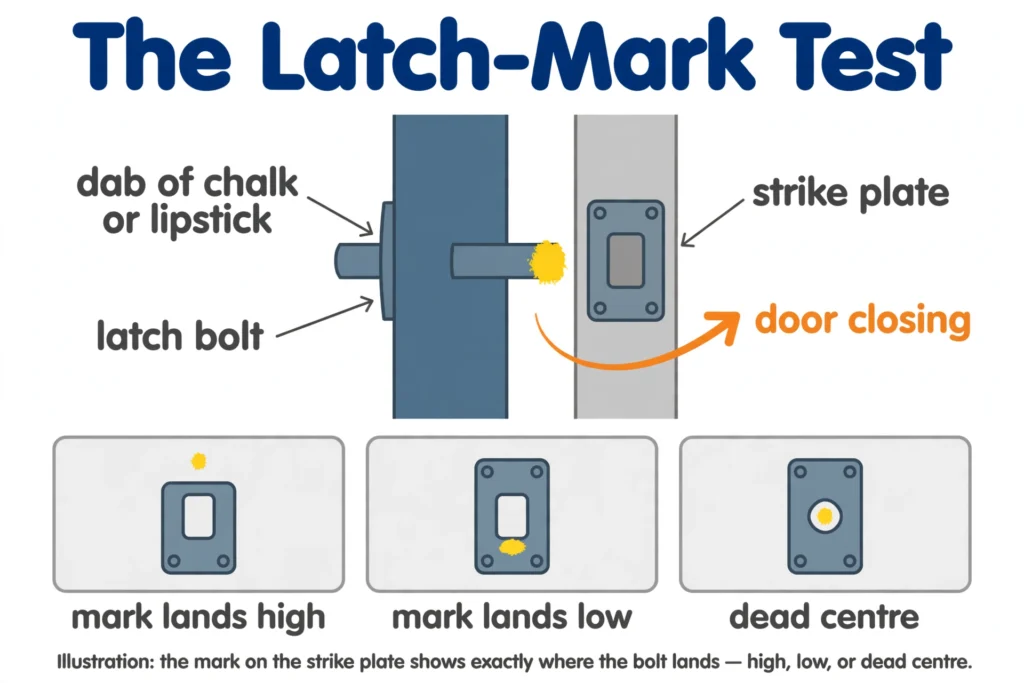
- Mark the bolt. Smear a thin dab of lipstick, chalk dust on a fingertip, or toothpaste across the end face of the latch bolt — the angled face that strikes the plate.
- Close the door gently, once. Close it the way it fails — do not lift the handle or force it. Let the bolt strike the plate, then open the door.
- Read the mark. The transferred mark on the strike plate shows exactly where the bolt lands:
- Mark below the hole — the door has dropped; the bolt is striking low. Hinge cause: go to the screw check, top hinge first.
- Mark above the hole — rarer; the door is sitting high, usually after a hinge or frame change, or the plate was fitted low. The plate position is the fix.
- Mark on the plate’s edge, short of the hole — the bolt is not reaching: the door is sitting too far out, or the latch itself is worn short. Check the frame-side hinge screws and the door’s gap first.
- Mark dead centre but the door still pops open — the bolt is entering but not holding: the bolt may be worn, the spring weak, or the hole worn wide. See “if that didn’t fix it”.
- Wipe the mark off before you adjust anything, so the next test mark is fresh.
Fix the alignment
Work in this order — door first, plate second. Moving the strike plate is a legitimate small fix, but it should not be used to hide a door that is still dropping.
- Fix the drop at the hinge. If the mark landed low, tighten the hinge screws (next section). A door pulled back up by even one millimetre often latches perfectly with no plate work at all. Re-run the latch-mark test after tightening.
- If the mark is still out by a fraction (1–2 mm), nudge the strike plate. Remove the plate’s two screws, and either reposition the plate by that fraction (you may need to pare a sliver of wood from the recess edge with a sharp chisel or craft knife — a millimetre, no more) or use the plate’s adjustment tab if it has one: many modern strike plates have a small metal tab in the hole that bends in or out to take up rattle and fine-tune the catch.
- If the hole is a fraction too small for a worn bolt, ease it with a file. Two or three strokes of a small file on the edge of the strike hole the mark pointed to — no more. File a little, test, file again only if needed. Do not file the bolt.
- Test the latch five times. Open and close normally, without lifting or pushing. It should click every time with the door’s own weight, and stay shut against a gentle pull.
The screw check (hinges and strike plate)
Exactly as in our sticking-door guide, because it is the same fault family: open the door and try every hinge screw, top hinge first, then the strike plate screws on the frame. Tighten what is loose. A screw that spins without gripping has a stripped hole: fit a longer screw (38–50 mm) so it bites into the frame behind, or pack the hole with glued matchsticks, let it set, drill a small pilot hole, and refit. A strike plate held by one stripped screw will flex every time the door closes, which is how a door can latch on Monday and rattle by Friday. Finish with the door-gap check: with the door latched, the gaps around it should be roughly even; a door hanging crooked will keep defeating small latch fixes.
Hinge lubrication — and what not to use
Do this after the screw check, because tightening a loose hinge silences some “squeaks” that were really movement.
- Find the noisy hinge. Open and close the door slowly and listen; usually one hinge does the singing.
- Apply a drop, not a flood. Put one or two drops of light machine oil on the hinge pin joint — the barrel — then swing the door a dozen times to work it in. A silicone or PTFE spray with the straw nozzle aimed at the joint works the same way. Wipe off any excess and protect the floor or carpet underneath in case of a drip.
- If the squeak persists, lift the pin. On loose-pin hinges, tap the pin up from below with a screwdriver and hammer, clean it, oil it, and tap it back. Only do this with the door supported, and only on hinges whose pins are designed to come out — many modern butt hinges have fixed pins and should just be oiled in place.
- What NOT to use: thick grease (it gums up with dust and stains), cooking or vegetable oil (it goes sticky and rancid), and penetrating sprays sprayed blindly into a keyhole or lock mechanism — locks need their own dry lubricant (graphite) if anything, and a stiff lock is a locksmith conversation, not a spray-can job.
A door that swings by itself
A door that drifts open or closed from a part-open position is hanging out of plumb — gravity is doing the swinging. It is an alignment fault, not a personality trait.
- Which way does it swing? A door that swings open is leaning toward the room it opens into; one that swings shut leans the other way. Either way, something at the hinges is out: a hinge not seated fully in its recess, a loose hinge pulling the door off level, or — in older houses — a frame that is itself slightly out of plumb.
- Check the hinges first. Tighten all screws (a loose hinge can tilt the door enough to swing it), and check each hinge leaf sits fully in its recess, flush with the door edge and frame. A leaf sitting proud on a paint ridge or a wood shaving tilts the door.
- Check with a level. Hold a spirit level against the hinge-side frame edge. If the frame itself is out of plumb and the house is old, the honest fix is a compromise: a door closer, a soft-close catch, or accepting the swing — re-hanging a door plumb in a crooked frame leaves uneven gaps everywhere.
- The cardboard shim trick (small corrections only). For a slight swing, a thin cardboard shim behind one hinge leaf — between leaf and frame — nudges the door’s hang. Behind the bottom hinge to stop a door swinging open, behind the top hinge for one swinging shut, one layer at a time, testing between. It is a fine-tuning fix for a millimetre of lean, not a cure for a dropped door: fix screws and stripped holes properly first.
When a worn hinge needs replacing
Replace a hinge when: the knuckle (barrel) has visible play — the door lifts and drops at the handle when you raise it gently; the leaves are bent; the pin is worn or the barrel is cracked; or screw holes are stripped in several places and repairs no longer hold. Replacement is a like-for-like swap, not an upgrade project: match the hinge’s size (a standard internal door butt hinge is about 75–100 mm / 3–4 in), its screw pattern, and its type (plain butt hinges for ordinary internal doors; fire doors and heavy
external doors need their rated hinges — a fire door’s hinges are professional work). Swap one hinge
at a time with the door supported on wedges, so the door never hangs from a single hinge, and use
the old hinge’s recesses — do not cut new ones unless a carpenter is involved.
Common mistakes
- Replacing the latch first. A new latch in a dropped door misses the plate in exactly the same place. Diagnose with the mark test; replace parts last.
- Moving the strike plate to hide a dropping door. The door keeps dropping; the plate runs out of adjustment; the real fault (a stripped top-hinge hole) is still there.
- Filing the latch bolt. A shortened or reshaped bolt may stop holding the door at all. File the plate hole, a fraction, or nothing.
- Spraying lubricant into the lock. It washes dirt into the mechanism and can gum it. Hinges get oil; locks are a locksmith’s call when stiff.
- Cooking oil or grease on hinges. Sticky, dusty, staining — light machine oil or silicone, a drop at a time.
- Tightening a spinning screw harder. Stripped holes need the longer-screw or packed-hole repair, not torque.
- Ignoring a fire door that will not latch. That is a safety fault, not an annoyance — professional fix, and renters report it in writing the same day.
If that didn’t fix it
The mark is dead centre, the screws are sound, the plate is adjusted — and the door still pops open. Now suspect the latch itself: a bolt worn rounded, or a weak or broken spring inside the latch case, so the bolt does not snap fully out. Test it with your thumb: press the bolt in and watch it spring back — it should snap out smartly and fully. A sluggish or short-throwing bolt means the latch is worn out. A plain tubular latch is a like-for-like part (match its case size — commonly 64 mm or 76 mm / 2½ in or 3 in overall — and its backset) and swapping the case is within this guide’s scope; but if the door has a mortice lock, a multipoint lock, or the handle mechanism itself is broken, stop: that is lock-mechanism territory and a locksmith’s job. If the door latches but the whole door sits crooked with uneven gaps that hinge work will not correct, the frame has moved — a carpenter’s assessment, and if other doors and windows have started misbehaving at the same time, read the “professional now” signs in our cracks guide first.
When to stop and call a professional
Stop and get help if: the handle turns but nothing moves, or the key will not turn (locksmith — mechanism fault); a fire door will not latch (competent fire-door professional; renters report in writing immediately); the door is an external door with a multipoint lock that will not align (locksmith or door specialist — forcing it risks a lockout); a hinge’s screws strip in rotten door or frame timber; or the misalignment arrived suddenly alongside new cracks or other doors sticking (building assessment first, door second).
Cost table
| Item | Typical cost |
|---|---|
| Latch-mark test, screw check, strike adjustment (DIY) | $0 / £0 |
| Longer screws, pack (DIY stripped-hole fix) | $2–$5 / £2–£4 |
| Light machine oil / silicone lubricant | $4–$10 / £3–£8 |
| Replacement strike plate | $3–$10 / £2–£8 |
| Replacement tubular latch, matched size (DIY) | $6–$18 / £5–£15 |
| Replacement butt hinge (DIY swap) | $5–$15 / £4–£12 per hinge |
| Locksmith call-out (broken mechanism) | $75–$200 / £60–£150, typical |
| Carpenter to re-hang / realign a door | $75–$200 / £50–£150 per door, typical |
US / UK term box
| US term | UK term used in this guide |
|---|---|
| Strike plate | Strike plate / keep |
| Latch bolt | Latch bolt (same) |
| Deadbolt | Mortice deadlock / rim lock (by type) |
| Backset | Backset (same) |
| Door jamb | Door lining / frame |
| Hinge barrel | Hinge knuckle |
| 3-in-1 oil | Light machine oil |
| Door casing / trim | Architrave |
FAQs
Why does my door latch only if I lift the handle?
Because the door has dropped on its hinges, so the bolt lands below the strike hole, and lifting the handle lifts the door back into line. The lasting fix is at the top hinge — tighten its screws or repair a stripped hole — not a lifetime of lifting the handle. Run the latch-mark test to confirm the bolt lands low.
Can I just move the strike plate down instead of fixing the hinge?
You can, and for a settled door that dropped years ago and has stopped moving, a 1–2 mm plate move is a fair fix. But if the door is still dropping, the plate move only buys time and hides the cause. Check the hinge screws first; move the plate for the last fraction, not the whole fault.
What is the best lubricant for squeaky hinges?
A drop of light machine oil (sewing-machine or 3-in-1 type) on the hinge pin joint, worked in by swinging the door. Silicone or PTFE spray also works. Avoid thick grease and cooking oil — they collect grit, go sticky, and stain. And keep sprays out of the lock itself.
My door swings shut by itself. Is that a hinge problem?
Usually, yes — the door is hanging slightly out of plumb, often from a loose hinge or a hinge leaf not seated flush. Tighten the screws, check the leaves sit flat, and try a thin cardboard shim behind one hinge for a small correction. In older houses the frame itself may be out of plumb, and then a door closer or accepting the swing is the honest answer.
The handle turns but the bolt does not move. Can I fix it myself?
No — that is a broken latch or lock mechanism, and dismantling it can leave the door unsecured. That is a locksmith’s job. The exception covered here is a plain worn tubular latch that still works but throws short; even then, if you are unsure which type you have, get it identified before taking anything apart.
Checklist
- [ ] Symptom sorted — won’t latch, latches only with a lift, rattles, swings, or squeaks
- [ ] Latch-mark test done and the landing point read (high / low / short / centre)
- [ ] Hinge screws checked, top hinge first; spinning screws repaired properly
- [ ] Strike plate screws tight; plate nudged or tab adjusted only for the last 1–2 mm
- [ ] Alignment re-tested — door clicks shut five times with no lift or push
- [ ] Hinges lubricated with a drop of light oil or silicone — nothing in the lock
- [ ] Swinging door: plumb checked, leaves seated flush, shim only for a slight lean
- [ ] Worn hinge replaced like-for-like, one at a time, door supported
- [ ] Broken mechanism, multipoint lock, or a fire door that won’t latch → professional