
By the FaultToFix team | Published: 28 October 2026 | Last updated: 28 October 2026
DIY level: Easy · Cost: £0 for the routine, £0–£150+ only if you add kit · Time: 10 minutes every morning, then it becomes habit
Quick Answer: Bedroom windows stream every morning because overnight you breathe out litres of warm, moist air, and the window is the coldest surface in the room — so that moisture lands there first. In most cases the windows are not broken. Where the condensation sits tells the real story: inside the glass means room moisture, between the panes means the sealed unit has failed, and outside the glass means the glazing is actually doing its job well. The fix for the common case is not a new window — it is a short morning routine: trickle vents open, a 10-minute purge with the bedroom door cracked, and background heat kept steady, plus drying-clothes and extractor rules that stop the moisture building up in the first place.
Key Takeaways
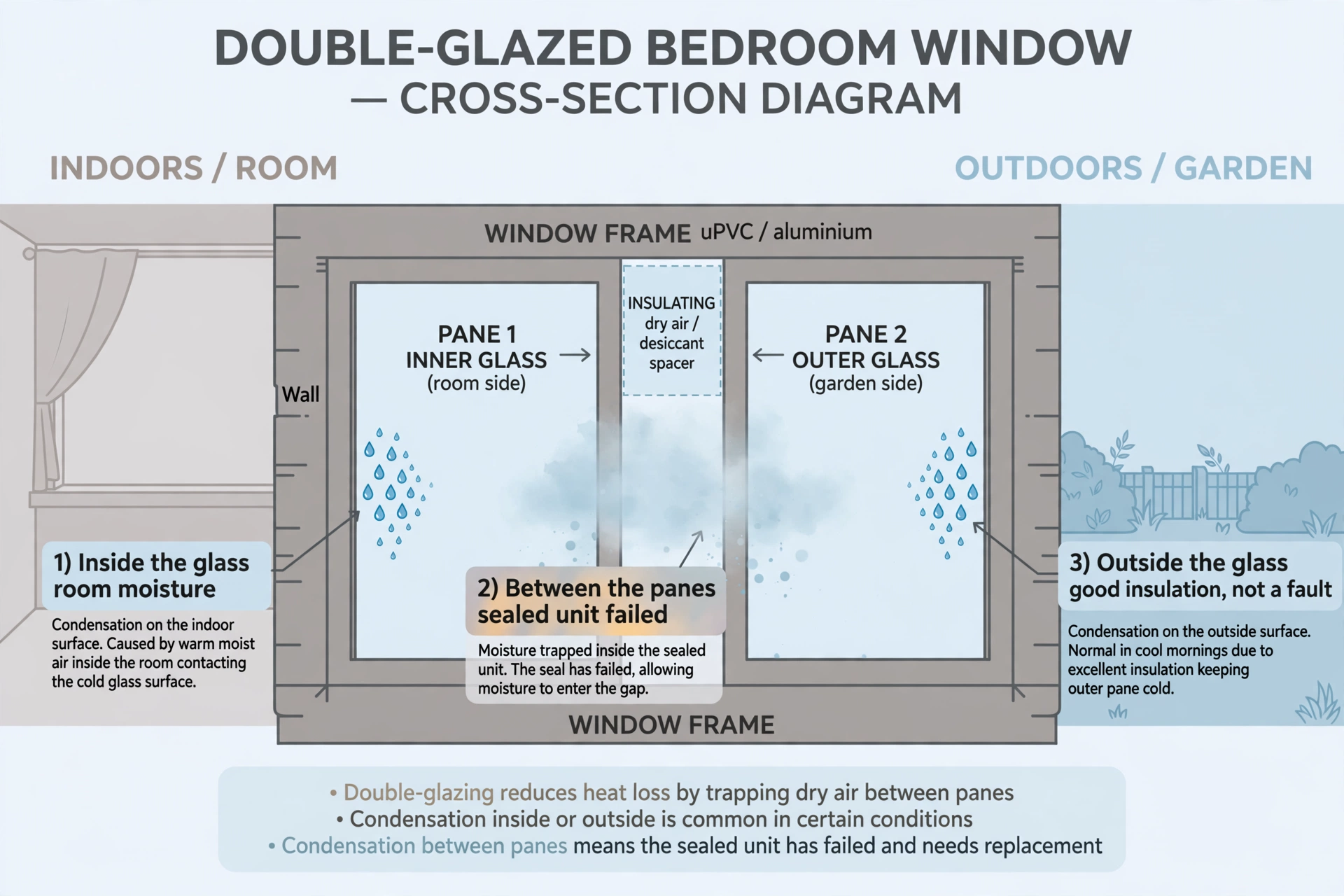
- Location is the diagnosis: inside = moisture in the room, between the panes = failed sealed unit, outside = good insulation, not a fault.
- Only “between the panes” means the window itself has failed. Everything else is fixed by air and heat, not by replacing glass.
- The morning routine takes 10 minutes: vents open, window purged, door gap left — and it only works if it happens every morning, not once a week.
- Drying clothes indoors is the biggest single moisture source in most homes in winter — one load can add more water to the air than a night of breathing.
- A dehumidifier helps, but it is a helper, not the fix: if the vents stay shut and clothes dry on radiators, the machine just works harder for the same result.
Jump to a Section
- Confirm the diagnosis · Symptom → cause table · The morning routine, step by step · Room-by-room causes · Drying clothes and extractor rules · Dehumidifier: when it is worth it · When it IS the window · Common mistakes · When to stop and call a professional · Cost table · US / UK term box · FAQs · Checklist
Safety box
Nothing in this guide involves opening a sealed glazing unit, removing glass, or altering a window frame — those are not DIY jobs, and a failed unit is a replacement, not a repair. Do not block trickle vents permanently, do not seal a room airtight to “keep the heat in”, and do not paint over or cover large areas of visible mould and call it fixed: a large or recurring mould patch is a sign the moisture problem is still there, and it belongs with a professional, or with your landlord if you rent. If condensation is running down walls, pooling on sills, or soaking plaster, that is beyond this guide — get it looked at rather than living with it through the winter.
First, confirm the diagnosis (one free check)
Check — where exactly is the water? Before you change anything, look at the glass in the morning and answer one question: inside, between, or outside?
- Inside the glass (the room side, you can wipe it off): room moisture condensing on a cold surface. This is the common case, and the routine below is written for it.
- Between the two panes (you cannot wipe it, it looks misty or streaked inside the unit): the sealed unit has failed — its seal has let moisture in. No amount of ventilation, wiping, or heating fixes this; the unit needs replacing (see “When it IS the window”).
- Outside the glass (the garden side, in the early morning): the outer pane is cold because the glazing is keeping heat inside. This is a sign of good insulation, not a fault, and it usually clears by itself once the sun is on it. Do nothing.
That one observation saves most people from the expensive mistake: replacing perfectly good windows to fix a ventilation problem, or ventilating for months to fix a failed unit.
Symptom → cause table
| What you notice | Most likely cause | First check |
|---|---|---|
| Streaming windows every morning, inside glass, wipes off | Overnight moisture + cold glass — breathing, plus a cold room and shut vents | Location check above, then the morning routine |
| Condensation only in one bedroom, not others | That room is colder, damper, or worse ventilated — north-facing, unheated, or door kept shut | Compare: is its radiator on, its vent open, its door cracked? |
| Windows clear in the morning but wet by evening | Daytime moisture load — cooking, showers, or clothes drying, not the night | Room-by-room table below |
| Misty, streaked, or permanently foggy glass you cannot wipe | Failed sealed unit — moisture trapped between the panes | Between-panes = replacement, not ventilation |
| Condensation on the outside in the morning, clearing by mid-morning | Good glazing doing its job — outer pane cold, inner pane warm | No action needed |
| Water pooling on the sill, paint peeling, or plaster damp | Sustained moisture, not a morning mist — ventilation plus a possible leak or cold bridge | Professional look — beyond this guide |
| Condensation that appeared after new double glazing | The room got more airtight — old draughty windows used to ventilate the room by accident | Vents and purge routine matter more, not less, after new glazing |
The morning routine, step by step
This is the whole fix for the common case, and it only works as a daily habit. Do it in this order, every morning, for two weeks before judging it.
- Open the trickle vents before you do anything else. Trickle vents are the narrow slots at the top of most modern window frames. If they are shut, the room has almost no background air — open them and leave them open through the winter, not just on “bad” mornings. If a vent is painted shut or missing, note it: that is a real fix worth doing, and it costs very little.
- Purge for 10 minutes. Open the bedroom window wide for about 10 minutes, ideally with another window or a door elsewhere in the home open so air actually moves through, rather than just sitting in one room. Ten minutes of wide-open ventilation loses far less heat than a window left cracked all day — and it removes the night’s moisture in one go.
- Leave the bedroom door cracked while you purge. A shut bedroom door traps the moist air in the room you are trying to dry. A finger-width gap is enough for air to move; you are not heating the hallway, you are letting the room breathe.
- Wipe the sill, then close up. If water is sitting on the sill, wipe it off so it does not soak into paint and plaster — a dry cloth takes 30 seconds. Then close the window, leave the trickle vent open, and let the room warm back up.
- Keep background heat steady, not on-off. A bedroom that is cold all day and blasted hot at night is a condensation machine: cold surfaces collect moisture all day, then the warm night air adds more. Steady, low background heat — a radiator on low, or a thermostat set so the room never goes fully cold — keeps the glass warmer and the air able to hold its moisture until the morning purge.
- Repeat tomorrow, even when the windows look clear. One clear morning does not mean the problem is solved; it means the routine worked that day. The habit is the fix.
Room-by-room causes
Bedroom condensation is rarely only a bedroom problem. Moisture travels through a home, so check where it is actually coming from:
| Room | Main moisture sources | What to change |
|---|---|---|
| Bedroom | Breathing overnight (two adults add a surprising amount), door shut, radiator off, vent shut | Morning routine above; radiator on low; door cracked |
| Kitchen | Cooking steam, boiling, no lid on pans, extractor off or venting into the room | Lids on pans; extractor on during cooking and 15–20 minutes after; never dry clothes on kitchen radiators |
| Bathroom | Showers and baths, extractor off, door left open so steam spreads to bedrooms | Extractor on during the shower and 15–20 minutes after (a run-on timer does this automatically); keep the bathroom door shut while steam is in the air |
| Living room | Clothes drying on radiators, open fire or unflued heater, plants in large numbers | Dry clothes properly (see below); move drying out of the living room if you can |
| Whole home | Cold, unheated rooms next to warm ones; furniture pushed hard against outside walls, trapping cold, still air | Keep every room at least a little warm; leave a small gap behind furniture on outside walls so air can move |
Drying clothes and extractor rules
Drying clothes indoors is the single biggest winter moisture source in most homes. A single load of washing can release roughly two litres of water into the air as it dries — more than a night of breathing in the bedroom. If that water has nowhere to go, it lands on the coldest surface it can find, which is usually a bedroom window.
- Best option: dry outside whenever the weather allows, even in winter — cold, moving air dries clothes, just more slowly.
- Second best: a tumble dryer that vents outside (not into the room), or a dehumidifier running in the drying room with the door shut and a window cracked.
- Worst option, and the most common: clothes draped over radiators in a shut room. The radiator heats the wet clothes, the water goes straight into the air, and the room’s windows pay for it. If you must dry indoors, use a clothes rack in one room, keep that room’s vent open, and shut the door so the moisture does not spread to bedrooms.
- Extractor run-on rule: bathroom and kitchen extractors should run during the steam and for 15–20 minutes after, not just while you are in the room. If yours has no run-on timer, leaving it on for that extra time by hand is worth it — and if it vents into the loft or a wall cavity instead of outside, that is a job to fix, because the moisture is just moving, not leaving.
Dehumidifier: when it is worth it
A dehumidifier is a useful helper, but it is not a substitute for the routine. Buy one only if the routine alone is not enough after two steady weeks, or if you have no practical way to dry clothes outside.
- When it helps: drying a load indoors, a room with no trickle vent, or a home where opening windows daily is genuinely impractical.
- When it does not: vents shut, clothes on radiators, and the dehumidifier left to fight the whole house — it will run constantly, cost more, and still lose.
- Running cost (UK, typical): a small modern dehumidifier uses roughly 150–250 watts, which at a typical domestic tariff works out at roughly £0.05–£0.10 per hour — but check your own tariff, because that number moves with it. Run it in the room you are drying in, with the door shut, rather than trying to dehumidify the whole house.
- Size note: buy by the room and the job (a small bedroom needs far less than a drying room), empty or drain it as directed, and clean its filter — a clogged filter is a common reason a dehumidifier quietly stops working.
When it IS the window
Replace, do not ventilate, when: condensation is trapped between the panes and cannot be wiped from either side; the unit is misty permanently, not just on cold mornings; or the seal has visibly failed (moisture, streaks, or mineral marks inside the unit). A replacement sealed unit — the glass unit alone, not the whole frame — is usually the economical fix, and it is a glazier’s job, not a DIY one. Get a like-for-like unit (same size, same glazing type) and ask whether the trickle vent is included or transferred, because losing the vent in the swap brings the condensation problem straight back with new glass.
Common mistakes
- Replacing windows to fix a ventilation problem. If the water wipes off the inside, the window is doing its job and the room needs air, not glass.
- Shutting trickle vents “to keep the heat in”. Shut vents save a little heat and create a lot of condensation — the trade is a bad one.
- Leaving a window cracked all day instead of purging for 10 minutes. All-day cracking loses more heat and removes less moisture than a short, wide purge.
- Drying clothes on radiators in a shut room. The single most common winter condensation habit, and the easiest to change.
- Wiping the glass and calling it done. Wiping protects the sill, but it does not remove the moisture from the air — only ventilation and heat do that.
- Painting over a damp patch or mould without fixing the moisture. The patch comes back, because the cause never left.
- Judging the routine after two days. Two weeks of daily purging is the fair test; a single cold snap is not.
When to stop and call a professional
Stop and get professional advice if: water is pooling on sills or soaking plaster; condensation runs down walls rather than just glass; a large or recurring mould patch is present; the sealed unit has failed and needs replacing; or the problem appeared suddenly after building work, a leak, or a new heating system. Renters should raise persistent damp with their landlord in writing rather than trying to fix a structural cause themselves — and keep a note of when it appears and what the routine has already covered.
Cost table (UK, typical)
| Item | Typical cost |
|---|---|
| Morning routine (vents, purge, wiping) | £0 |
| Trickle vent replacement (if painted shut or missing) | £5–£20 per vent, DIY |
| Extractor run-on timer (if fitting a new extractor) | £15–£40 for the timer feature |
| Dehumidifier (small, modern) | £100–£150 to buy; roughly £0.05–£0.10/hour to run |
| Replacement sealed glazing unit (glazier) | £100–£300+ per unit, size and type dependent |
| Replacement window frame (only when the frame itself has failed) | £300–£800+ per window |
US / UK term box
| US term | UK term used in this guide |
|---|---|
| Window vent / slot vent | Trickle vent |
| Dehumidifier | Dehumidifier (same) |
| Radiator / baseboard heater | Radiator |
| Exhaust fan | Extractor fan |
| Double-pane window | Double glazing / sealed unit |
| Landlord (rental) | Landlord (same) |
FAQs
Does condensation on bedroom windows mean my double glazing has failed?
Only if the water is between the panes, where you cannot wipe it. Water on the inside of the glass means room moisture meeting a cold surface — a ventilation and heating issue, not a failed window. Water on the outside in the morning usually means the glazing is working well.
Why is it only the bedroom, not the rest of the house?
Because the bedroom is where you spend 7–8 hours breathing in a shut, often unheated room, and it is usually the coldest room in the morning. The moisture is made in the bedroom; other rooms either have extractors or are warmer during the day.
Will opening the window in winter not just waste heat?
A 10-minute wide-open purge loses far less heat than a window cracked all day, because the walls and furniture stay warm and reheat the room quickly. The heat you lose in 10 minutes is small; the moisture you remove is the whole point.
I dry clothes indoors because I have no garden. What should I do?
Use one room for drying, shut its door, run a dehumidifier in that room if you have one, and keep its vent open. Do not dry on radiators in bedrooms or the living room, and never dry in a room with the door open to the bedrooms.
Is a dehumidifier better than opening windows?
Not as a replacement. Ventilation removes moisture and brings in fresh air; a dehumidifier only removes moisture and costs money to run. Use ventilation first, and add a dehumidifier only for drying loads or rooms where ventilation is genuinely impractical.
The condensation started after I got new windows. Did they fit them wrong?
Probably not — new, well-sealed windows stop the accidental draught ventilation the old windows provided. The room is now more airtight, so it needs its trickle vents open and the morning purge more, not less. If a new unit itself is misty between the panes, that is a different matter — that is a failed unit, and the installer should replace it.
Checklist
- [ ] Location checked — inside, between, or outside the glass
- [ ] Trickle vents open, and left open through winter
- [ ] 10-minute morning purge done, bedroom door cracked
- [ ] Sill wiped dry after purging
- [ ] Background heat steady — bedroom never fully cold
- [ ] Kitchen and bathroom extractors run 15–20 minutes after steam
- [ ] Clothes drying moved out of bedrooms, never on radiators in a shut room
- [ ] Routine kept daily for two weeks before judging it
- [ ] Between-panes misting, pooling water, or large mould patch referred to a professional / landlord