By the FaultToFix team | Published: 26 October 2026 | Last updated: 26 October 2026
DIY level: Diagnosis only — every check happens outside the boiler · Cost: £0 to diagnose · Engineer costs at the end, if it comes to that · Time: 10 minutes per check, plus 3 heating cycles of logging
Quick Answer: If your boiler pressure keeps dropping and you can’t see a leak, the water is still escaping somewhere — a sealed system can’t lose pressure any other way. The three usual culprits, in order, are: a tiny leak (often at a radiator valve, evaporating before it ever drips), a failed expansion vessel letting pressure vent outside, and the pressure relief valve letting water out through its discharge pipe. The checks below find which one you have — safely, from outside the boiler.
Key Takeaways
- A sealed system can’t lose pressure without losing water. No visible leak just means the leak is small, hidden, or venting outside.
- The pressure log is the diagnosis. One reading means little; the pattern across cold and hot readings over 3 cycles is what names the fault.
- Slow steady drop = micro-leak (kitchen-roll test finds it). Big hot rise then low cold reading = expansion vessel. Wet outside pipe = relief valve passing.
- Topping up is diagnosis time, not a fix. Topping up more than about once a month means a fault to find.
- The boiler casing stays on. Vessel and relief-valve repairs are engineer-only — this guide never opens the case.
Jump to a Section
- Most likely cause box · Start a pressure log · Symptom → cause table · Check 1: kitchen-roll test · Check 2: outside discharge pipe · Check 3: watch the gauge · A word on topping up · Common mistakes · When to call a pro · Cost table · US / UK term box · FAQs · Checklist
Safety box — read this first
Every check in this guide happens outside the boiler: radiator valves, one pipe outside the house, and the pressure gauge on the front. The boiler casing stays on. You are never asked to open the case, touch a gas part, or adjust anything inside — in the UK that work is legally for a Gas Safe registered engineer only, and nothing here needs it. If you smell gas, stop, don’t touch switches, ventilate, leave, and call the Gas Emergency line (0800 111 999 in the UK). If water is actively dripping from inside the boiler case, switch the boiler off at its isolator, put a container under it, and skip straight to “When to call a pro.”
Most likely cause box
- Pressure drops slowly over days/weeks, gauge normal while heating runs → micro-leak somewhere on the system (radiator valve joints are the classic spot)
- Pressure fine when cold, climbs high when hot, then reads low next morning → expansion vessel has lost its charge or failed — excess pressure escapes via the relief valve while hot
- Wet patch or dripping at the small pipe outside the house → pressure relief valve (PRV) is passing water
- Pressure drops right after bleeding radiators → that’s just the bleeding — top up once and watch; only worry if it keeps falling
Step 1 — Start a pressure log (this is what finds the fault)
Guessing wastes engineer visits. A simple log turns “it keeps dropping” into a pattern an engineer — or you — can diagnose:
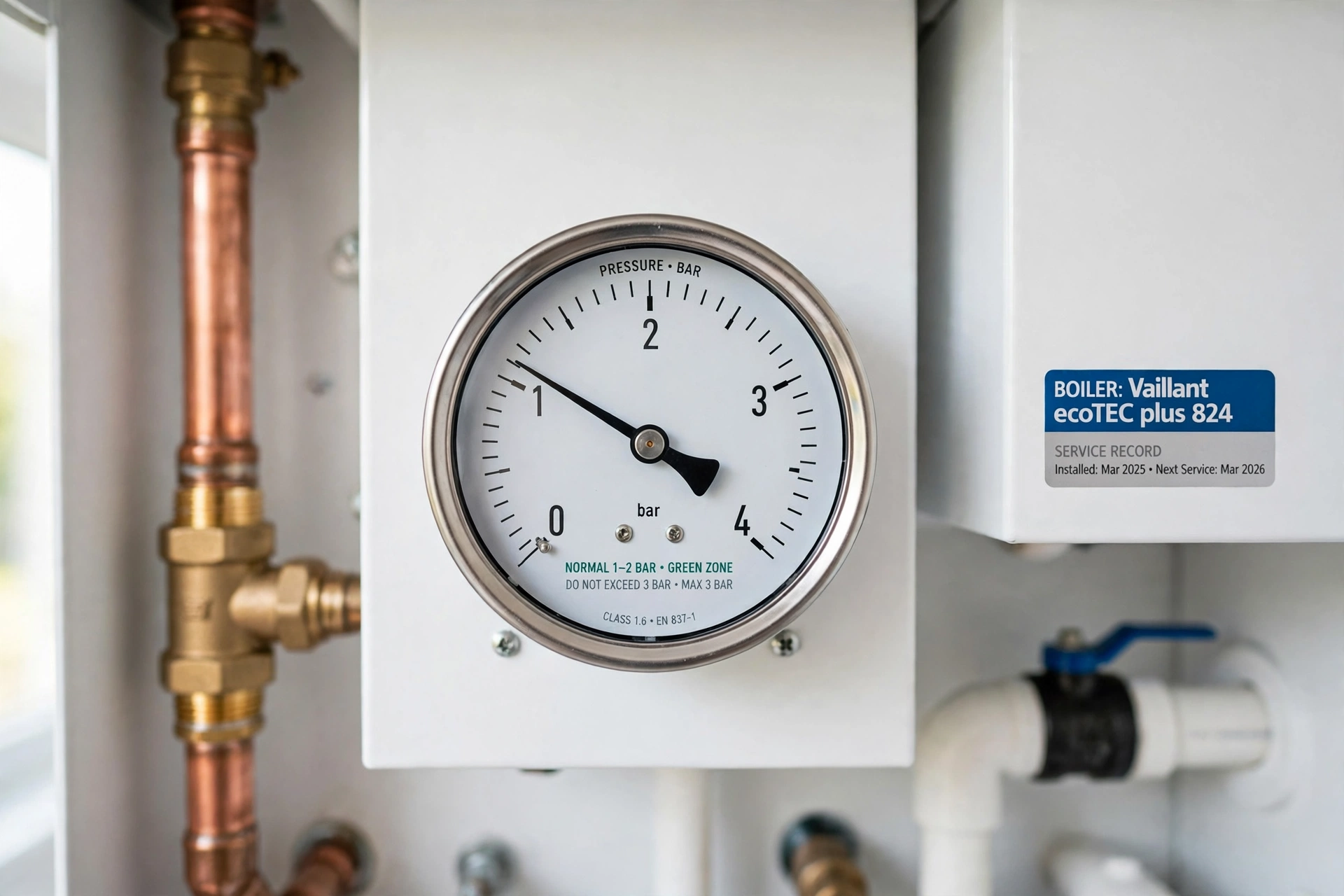
- Find the pressure gauge on the front of the boiler (some boilers show it on the digital display instead; check your manual for where).
- Cold reading: with the heating off and the system cold (first thing in the morning is ideal), write down the pressure. A healthy cold system usually sits around 1–1.5 bar.
- Hot reading: run the heating for an hour, then write down the pressure again. It should rise — normally by roughly 0.3–0.5 bar.
- Repeat for 3 normal heating cycles (about 2–3 days), noting cold and hot readings each time, and roughly how much you topped up, if you did.
- Read the pattern against the cause table below. The pattern — not any single reading — is the diagnosis.
Symptom → cause table (all checks are outside the boiler)
| What the log shows | Most likely cause | Safe homeowner check |
|---|---|---|
| Slow, steady drop over days; hot rise normal | Micro-leak on a radiator valve, joint or under a floor | Check 1 — kitchen-roll test on every radiator valve |
| Cold pressure OK, hot pressure climbs by more than 1 bar, next cold reading lower | Expansion vessel flat or failed — pressure vented out while hot | Check 3 — the gauge behaviour itself is the evidence; then call an engineer |
| Wet ground / drip at the outside discharge pipe | PRV passing, or vessel fault pushing water out through it | Check 2 — look at the external pipe |
| Drop started right after bleeding radiators | Air removed = pressure removed. Normal, once | Top up to ~1.5 bar cold; only investigate if it falls again |
| Sudden drop to zero, boiler locks out | Bigger leak, or PRV stuck open after venting | Look for the leak with lights on; if none is visible, engineer — don’t keep topping up |
Check 1 — The kitchen-roll test on radiator valves (10 minutes)
Most “invisible” leaks are at radiator valve joints, and they evaporate on a warm pipe before a drip ever forms — which is why there’s no puddle and no stain.
- With the system cold, take a sheet of dry kitchen roll (or tissue) and wipe it firmly around every radiator valve joint — both bottom corners of every radiator, including the bleed point at the top corner.
- Check the sheet after each valve: any damp patch, however small, is your leak. Mark the radiator with a sticky note.
- Also run a dry hand under each valve and along the pipe where it enters the floor — your fingers will feel dampness your eyes miss.
- Look for the green/white crusty deposits that slow leaks leave on copper joints — they mark a joint that weeps even when it feels dry today.
A weeping valve joint is a small job (often just a gland nut nip-up or a valve replacement), but the valve itself is where your role ends if it needs replacing and the system draining — note which radiator it is and give that to the engineer; it saves their time and your callout cost.
Check 2 — The outside discharge pipe (2 minutes)
Your boiler’s pressure relief valve vents through a pipe that usually comes out of the external wall near the boiler (often a small copper pipe ending pointing down, sometimes into a drain).
- Find that pipe outside and look at its end: is it dripping, wet, or is the ground/wall below it damp or stained?
- A dry pipe that has clearly been dry for a long time rules this route out. A wet pipe means water IS leaving the system under pressure — either the PRV itself is passing, or the expansion vessel has failed and is pushing the pressure out through the PRV while the heating runs.
- Don’t cap, block or bend this pipe closed — it is a safety outlet. Note what you saw; it’s exactly the evidence an engineer needs.
Check 3 — Watch the gauge while the heating runs (one cycle)
This check is just watching — and it separates the top two causes cleanly.
- Note the cold pressure (Step 1), then turn the heating on.
- Check the gauge after 45–60 minutes of running. A rise of about 0.3–0.5 bar is normal expansion.
- A rise of more than 1 bar (for example 1.2 bar cold → 2.5+ bar hot) points at the expansion vessel: the vessel’s air cushion is meant to absorb that expansion, and if it has lost its charge or its diaphragm has failed, the pressure has nowhere to go — so the PRV vents it away, and the system reads lower once cold.
- Recharging or replacing a vessel is inside-the-case work — engineer only. Your log (cold reading, hot reading, dates) is the deliverable; it turns a vague callout into a targeted repair.
A word on topping up
Topping up through the filling loop to ~1–1.5 bar (cold) is a normal homeowner task — your boiler manual shows the exact method for your model, and manufacturers publish walk-throughs for it. But treat topping up as buying diagnosis time, not as the fix: if you’re topping up more than about once a month, the system is telling you something, and every top-up lets in a little fresh oxygenated water that speeds up corrosion and sludge (see Radiator Cold at the Bottom but Hot at the Top). An engineer who finds you topping up weekly will ask the same question this article asks: where is the water going?
Common mistakes
- Topping up forever instead of finding the leak. Weekly top-ups are a fault to find, not a routine to keep up — and each one feeds corrosion and sludge.
- Diagnosing from a single reading. One low gauge reading after bleeding is normal; one high reading on a hot system is normal. Only the pattern across 3 cycles names the fault.
- Capping or blocking the discharge pipe. It is a safety outlet. A wet pipe is evidence, not something to hide.
- Opening the boiler casing to look. Vessel and PRV work is inside-the-case work — Gas Safe engineer only, no exceptions.
- Skipping the kitchen-roll test. Eyes miss weeps that evaporate on warm pipes; the tissue test catches what eyes can’t see.
When to stop and call a pro
Any of these red flags — Gas Safe registered engineer (UK), and never open the case yourself:
- Water dripping from inside the boiler case, or a wet boiler underside
- Pressure dropping to zero within hours, repeatedly, or the boiler locking out on low pressure again and again
- The gauge pattern showing the vessel fault (Check 3) — the repair is internal
- A PRV that drips constantly, or a discharge pipe that runs whenever the heating is on
- Any smell of gas (that’s the emergency line first — 0800 111 999 — then an engineer), scorch marks, or unusual banging from the boiler itself
Rough UK costs, for orientation only (region and boiler model change these): a diagnostic callout is often £60–£100; an expansion-vessel recharge/replacement is commonly in the £150–£350 range fitted; a PRV replacement is usually less. Your pressure log genuinely shortens the visit — bring it.
Cost table
| Fix | Who does it | Typical cost |
|---|---|---|
| Pressure log + 3 checks | DIY | £0 |
| Topping up via the filling loop | DIY | £0 |
| Diagnostic callout | Heating engineer | Often £60–£100 |
| Expansion-vessel recharge/replacement, fitted | Heating engineer | Commonly £150–£350 |
| PRV replacement | Heating engineer | Usually less than a vessel job |
| Weeping valve joint / valve replacement | Heating engineer | Small job; part + labour, quoted before the visit |
US / UK term box
Reading from the US? This guide is written for UK sealed combi/system boilers. US hydronic boilers work the same way physically — closed loop, expansion tank (the US name for the expansion vessel), pressure relief valve — but pressures are read in psi (a typical US cold fill is ~12 psi, roughly 0.8 bar), and boiler work licensing is state-by-state; use a licensed heating contractor for anything internal. Bar is the metric pressure unit on UK gauges: 1 bar ≈ 14.5 psi. Kitchen roll = paper towel. Gas Safe engineer = licensed gas/heating contractor.
FAQs
What should my boiler pressure be?
For most UK sealed systems: about 1–1.5 bar when cold, rising to roughly 1.5–2 bar when hot. Your manual gives your model’s exact range — if in doubt, work to the manual, not a general guide.
How often is topping up too often?
Once or twice a year can be normal (especially after bleeding radiators). Once a month or more means water is leaving the system — that’s a fault to find, not a routine to keep up.
Can a leak really be invisible?
Yes — it’s the most common version of this problem. A weep at a radiator valve on a warm pipe evaporates before it drips, and underfloor pipework can leak slowly into the void below with no mark on the ceiling for a long time. That’s why the kitchen-roll test (Check 1) and the log (Step 1) matter: they catch what eyes can’t see.
Is low boiler pressure dangerous?
Low pressure itself mostly causes the boiler to lock out and stop — an inconvenience, not usually a danger. The serious directions are the other ones: pressure climbing far too high, water escaping inside the case, or any gas smell. Those are stop-and-call situations (see the red-flag list).
My pressure only drops after I bleed a radiator — is that the same fault?
No. Bleeding lets air out, and air was part of the system’s pressure, so the gauge falls — that’s expected, once. Top up to ~1.5 bar cold afterwards. Only treat it as this article’s problem if the pressure keeps drifting down between bleeds.
Checklist
- Find the gauge (front of boiler, or digital display — check your manual)
- Cold reading first thing in the morning, heating off, system cold — write it down
- Hot reading after an hour of heating — normal rise roughly 0.3–0.5 bar
- Repeat for 3 heating cycles (about 2–3 days), noting any top-ups
- Match the pattern to the cause table — don’t diagnose from one reading
- Kitchen-roll test on every radiator valve joint, both bottom corners + bleed point
- Check the outside discharge pipe end: dry, damp, or dripping?
- Watch one full cycle: rise over 1 bar = vessel pattern → engineer
- Top up to ~1–1.5 bar cold via the filling loop (your manual’s method)
- Topping up more than monthly, or any red flag → stop, call a Gas Safe engineer, bring the log
Related guides
- Heating pillar: https://faulttofix.com/heating/
- Radiator Cold at the Bottom but Hot at the Top — sludge pattern, and why topping up feeds it: https://faulttofix.com/radiator-cold-at-bottom/
- One Radiator Not Working — stuck TRV pin, when one radiator is cold: https://faulttofix.com/one-radiator-not-working-trv-pin/
- One Room Always Cold — balancing, when one room lags the rest: https://faulttofix.com/one-room-always-cold/
- Radiator Gurgling — air in the system, and when noise means a leak too: https://faulttofix.com/radiator-gurgling-noises/
Sources line: pressure figures are the standard UK sealed-system ranges (1–1.5 bar cold; ~0.3–0.5 bar normal hot rise; over 1 bar rise = vessel pattern), labelled usually/roughly; PRV discharge-pipe routing described as “usually” because installations vary; costs are rough UK orientation ranges only. Guidance basis: Worcester Bosch homeowner guidance on boiler pressure and repressurising; Gas Safe Register guidance on why internal boiler work is engineer-only (confirm exact page URLs at publish time).