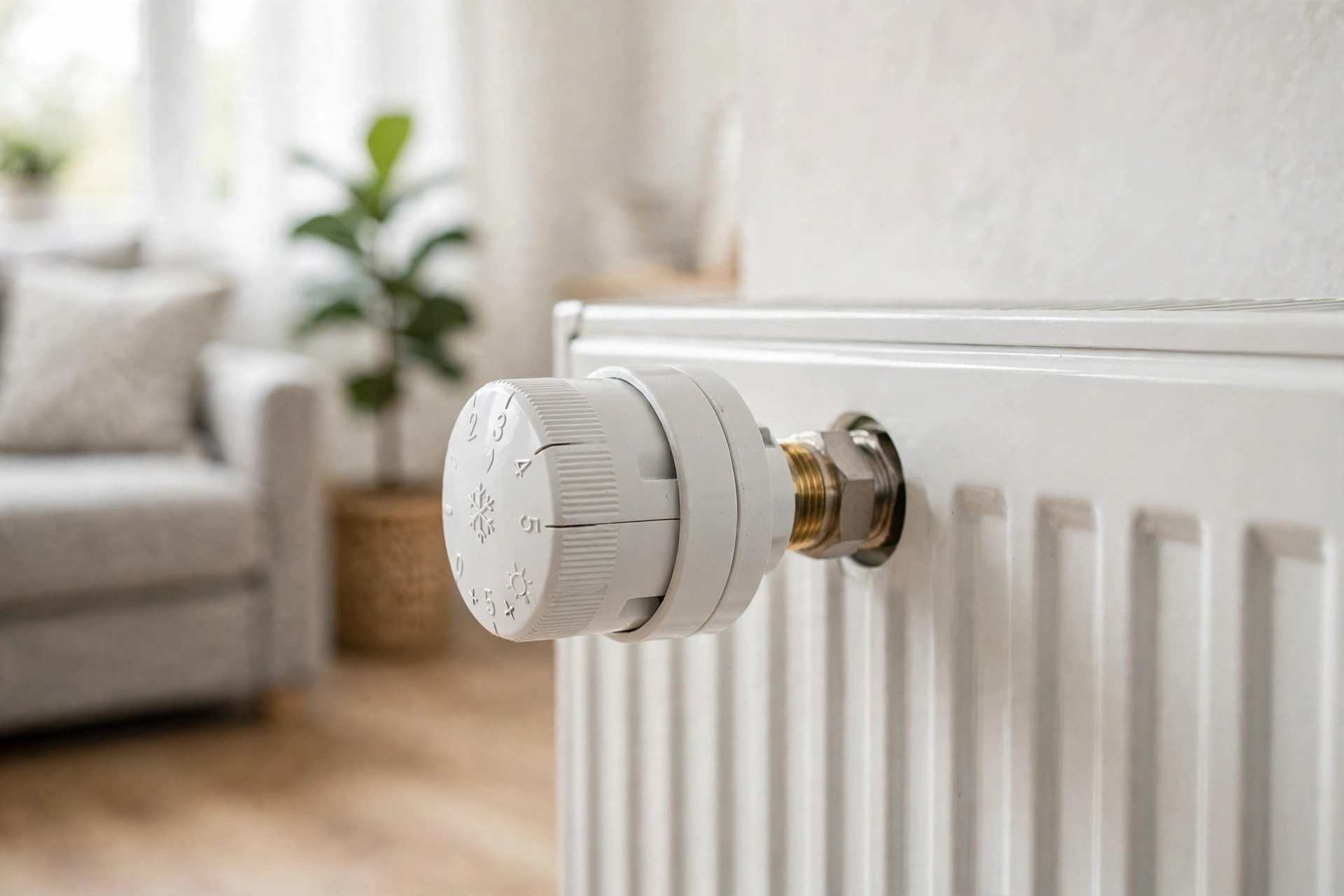
By the FaultToFix team | Published: 26 October 2026 | Last updated: 3 November 2026
DIY level: Easy · Cost: £0 if the pin frees · £10–£30 for a replacement TRV if it doesn’t · Time: 5–15 minutes
Quick Answer: If one radiator stays stone cold while the rest of the house heats up, the most common cause is the TRV pin seized in the down (closed) position after months shut over summer. The fix is free and takes minutes: take the TRV head off, free the small pin underneath so it springs up again, refit the head, and test. Work through the checks below first — they make sure the pin really is the problem before you touch anything.
Key Takeaways
- One cold radiator + hot rest of house = valve problem, not boiler problem. Start at the radiator, not the boiler.
- The TRV pin seizes over summer because it sits pressed down for months while the heating is off.
- A healthy pin moves only 2–3 mm and springs back when pressed — that small travel is all it takes.
- Never pull the pin up with pliers — pressing down and letting the spring push it back is the safe motion.
- Count any lockshield turns you make so you can restore the system’s balance afterwards.
Jump to a Section
- Confirm the diagnosis · Rule out the other valve · What you need · Free the pin, step by step · If that didn’t fix it · Stop it sticking again · Common mistakes · When to call a pro · Cost table · US / UK term box · TRV not working — which part has failed · Should the pin be up or down · FAQs · Checklist
Safety box
This job touches only the outside of the thermostatic radiator valve (TRV) — you are not opening any pipework, so no draining is needed and the system can stay full. Work with the radiator cool. Never open a boiler case or touch gas parts — that is Gas Safe (UK) / licensed-technician (US) work only, and nothing in this guide needs it. If water starts leaking from the valve body at any point, stop, put a container under it, and skip to “When to call a pro.”
First, confirm the diagnosis
Turn the heating on, let the system run for 15 minutes, and confirm the pattern: other radiators hot, this one cold all over. A radiator that is hot at the top and cold at the bottom is a different fault — sludge; see Radiator Cold at the Bottom but Hot at the Top. A radiator cold at the top only is trapped air — bleed it.
- Turn this radiator’s TRV dial up to 5 (maximum). Wait 10 minutes. Still completely cold? Continue.
- Feel the two pipes at the bottom corners. If the pipe on the TRV side is hot but the panel stays cold, hot water is arriving and the valve is not letting it through — classic stuck-pin territory. If both pipes are cold too, the problem may be the other valve (next section) or system balancing, not the pin.
| What you notice | Most likely cause | First check |
|---|---|---|
| Whole radiator cold, rest of house hot, TRV pipe hot | TRV pin stuck down | Remove the head and check the pin |
| Whole radiator cold, both pipes cold | Lockshield (other valve) closed, or balancing | Rule out the other valve, below |
| Cold at the TOP, hot at the bottom | Trapped air | Bleed the radiator |
| Hot at the TOP, cold at the bottom | Sludge settled in the panel | See Radiator Cold at the Bottom — bleeding won’t fix it |
| Radiator warms a little but never gets hot | Pin moving only part-way, or balancing | Free the pin fully; then check balancing |
Rule out the other valve first (1 minute)
At the opposite bottom corner is the lockshield valve, often under a plain push-on plastic cap. Pull the cap off and check the spindle underneath is open (turn anti-clockwise with a small spanner if needed — and if you move it, count the turns so you can put it back; lockshields set the system balance). If it was fully closed — for example after decorating — that alone explains a cold radiator. Open it a turn, test for 15 minutes, and only move on if the radiator is still cold.
You need
- Adjustable spanner or pliers — for the TRV head’s knurled ring and the lockshield cap spindle.
- Penetrating oil (e.g. WD-40) — one drop only.
- A flat, smooth tool to press the pin — the flat side of a spanner or the back of a spoon handle (nothing sharp, nothing that can slip).
- An old cloth — for oil drips and grip.
- Optional: replacement TRV — standard UK size is 15 mm; a complete TRV (head + body) is roughly £10–£30 at DIY stores. US thermostatic radiator valves differ — see the term box.
Free the pin, step by step
- Turn the TRV dial to its highest setting, then remove the head. On most UK TRVs the knurled metal ring at the base of the head unscrews anti-clockwise by hand or with the spanner; some heads have a release clip or a small Allen screw instead. Lift the head off and set it aside. This does not open any waterway.
- Look at the top of the valve body. You should see a small metal pin in the centre. It should sit up, proud of the body, and spring back when pressed. A healthy pin moves only a few millimetres — that small travel is all it takes to open and close the valve.
- If the pin is stuck down flush or barely moves: put one drop of penetrating oil around the pin and wait 2–3 minutes.
- Press the pin straight down with the flat tool and let it spring back. Repeat, working it up and down. You can also tap the side of the valve body gently with the spanner handle — vibration helps a seized pin release. Be patient; most pins free within a few minutes of this.
- Do not haul the pin upward with pliers. A gentle wiggle is fine, but pulling hard can damage the seal inside the valve and turn a free fix into a leak. If it will not move with pressing, oil and tapping, it is replacement time (below).
- Once the pin springs freely, refit the head: seat it over the pin, tighten the ring hand-tight plus a small nip with the spanner, and set the dial to your normal number.
- Test it worked: heating on, TRV at 5 — the panel should start warming within 10–15 minutes and be evenly hot within one heating cycle.
If that didn’t fix it
- Pin moves freely but the radiator is still cold: the fault is elsewhere — re-check the lockshield (above), bleed the radiator in case of air, and if several radiators are uneven, the system likely needs balancing. See One Room Always Cold for the balancing method.
- Pin will not move at all, or the valve weeps water around the pin after freeing: the valve body itself has failed. Replacing a TRV body means partially draining the system — a confident DIYer can do it, but for most homeowners this is the point to call a heating engineer; expect the part (£10–£30) plus labour. A new TRV head alone (roughly £8–£20) only fixes a faulty head, not a seized body pin.
Stop it sticking again
The seizure happens because the pin sits pressed down for months over summer. Once a summer, turn every TRV fully on and fully off a couple of times — that short exercise keeps the pins moving and costs nothing. Do it when you first notice the days shortening, before the heating season starts, and this radiator will not greet October stone cold again.
Common mistakes
- Pulling the pin up with pliers. Pressing down and letting the spring push it back is the safe motion. Pulling hard can tear the internal seal and cause a leak at the valve.
- Skipping the lockshield check. A closed lockshield after decorating explains a cold radiator all by itself — check it before blaming the pin.
- Forgetting to count lockshield turns. Move a lockshield without counting and you lose the system’s balance on reopening; a different radiator can go lukewarm next.
- Replacing the head when the body has failed. A new head (£8–£20) fixes a faulty head, not a seized body pin — if the pin will not move, the body is the problem.
- Assuming the boiler is at fault. One cold radiator with a hot house is a radiator-level fault. Work through the radiator checks before paying for a boiler call-out.
When to stop and call a pro
- Water leaking from the valve body or pin that doesn’t stop when the head is refitted.
- The pin is corroded, bent, or the valve body is cracked.
- Several radiators are cold, or boiler pressure keeps dropping — that is a system problem, not one valve (see Boiler Pressure Keeps Dropping — diagnosis only).
- Anything that would require opening the boiler. In the UK, gas work must be done by a Gas Safe registered engineer.
Cost table
| Fix | Who does it | Typical cost |
|---|---|---|
| Pin check and free | DIY | £0 |
| Penetrating oil (one drop used) | DIY | A few pounds a can, already in most homes |
| Replacement TRV head alone | DIY | ~£8–£20 |
| Complete replacement TRV (head + body) | DIY or engineer | ~£10–£30 for the part |
| TRV body replacement, fitted | Heating engineer | Part (£10–£30) plus labour — roughly £60–£120 total |
US / UK term box
Reading from the other side of the Atlantic? TRV = thermostatic radiator valve (UK) — the same device is sold in the US as a thermostatic radiator valve / radiator thermostat, common on steam and hot-water radiators in older US homes; most US homes with forced-air furnaces don’t have them. Spanner = wrench. Lockshield = the balancing valve on the return side (US: lockshield / shut-off valve). Anti-clockwise = counterclockwise. Heating engineer = HVAC / hydronics technician.
TRV not working? Work out which part has failed
A TRV has three parts that can fail, and each one fails differently: the head (the numbered dial you turn), the pin (the small metal pin under the head), and the valve body (the brass part plumbed into the pipe). Before you buy anything, work out which one you have — the 60-second test is to take the head off (steps above) and look at the pin.
| What you find | Which part has failed | The fix |
|---|---|---|
| Dial turns normally, but the pin is stuck down flush | Pin seized in the body | Free the pin — the step-by-step above |
| Dial will not turn at all, or feels seized solid | Head mechanism failed | Do not force it with tools; a replacement head alone is roughly £8–£20 |
| Dial spins loosely without its usual clicks or stops | Head coupling worn or cracked | Refit the head once; if it still spins, replace the head |
| Pin springs freely and the radiator heats with the head OFF, but goes cold with the head back ON | Head sensor has failed — it is pressing the pin down when it shouldn’t | Replace the head only; the body and pin are fine |
| Pin springs freely, lockshield is open, radiator still stone cold | Not the TRV at all | Bleed for air, then check balancing — see One Room Always Cold |
Heads fail more often than bodies: the sensor inside the head (a wax or liquid capsule that expands and pushes the pin down as the room warms) weakens with age. That is why a radiator that will not turn down, or one that goes cold even at setting 5 with a healthy pin, is usually a head problem — and a head swaps in minutes with no draining.
Should the TRV pin be up or down?
Up is open, down is closed. With the head removed, a healthy pin sits up, proud of the valve body, and springs back up when you press it down. As the room reaches the temperature you set, the head gradually presses the pin down to close the valve — that movement is only about 2–3 mm, but it is the whole travel between fully open and fully closed.
So the two stuck positions tell the story: a pin stuck down means a radiator that never heats; a pin (or head) that never presses down means a radiator that never turns off and a room that overheats. If your pin sits somewhere in between and only moves part-way, the radiator usually warms a little but never gets properly hot — work it free with the oil-and-press routine above before you replace anything.
FAQs
Why do TRV pins stick over summer?
The pin sits pressed down in the closed position for months while the heating is off, and corrosion and limescale gradually seize it there. Turning every TRV fully on and off a couple of times during summer is the simple prevention.
How far should a TRV pin move?
Only a few millimetres — roughly 2–3 mm of travel opens and closes the valve. If it sits flush and won’t spring back when pressed, it’s stuck; if it moves that small amount freely, it’s healthy.
Can I just pull the pin up with pliers?
Don’t. Pressing down and letting the spring push it back is the safe motion. Pulling hard can tear the internal seal and cause a leak at the valve — if pressing, oil and gentle tapping don’t free it, the valve needs replacing.
The pin is free but the radiator is still cold — what now?
Check the lockshield at the other corner is open, bleed the radiator for air (cold top = air), and consider system balancing if other radiators are also uneven. If the inlet pipe itself never gets hot, the problem is upstream of this radiator.
How much does a heating engineer charge to replace a TRV?
Typically the part (£10–£30) plus around an hour’s labour if the system cooperates — as a rough guide, £60–£120 total in the UK depending on region. Get the quote before the visit; draining a full system takes longer and costs more.
How do I know if my TRV is working?
Take the head off and press the pin: it should move 2–3 mm and spring straight back. Then test with the head refitted — at setting 5 the radiator should heat fully, and turned down to 1 on a warm day the radiator should cool as the head presses the pin down. A TRV that passes both tests is working; a failure at the pin points to the body, a failure only with the head on points to the head.
What are the signs of a faulty TRV?
The common signs are: one radiator stone cold while its inlet pipe is hot; a radiator that overheats and will not turn down; a dial that is seized solid or spins without clicks; the radiator heating only when the head is removed; and weeping water around the pin or head. Each sign points to a different part — the table above (“TRV not working?”) matches the sign to the fix.
My TRV will not turn — what should I do?
Do not force the dial with pliers or grips — that cracks the head. A seized dial almost always means the head mechanism has failed, not the pin. Take the head off (the ring unscrews, or there is a release clip), check the pin underneath is free, and if it is, simply fit a replacement head (roughly £8–£20). The radiator can run safely with the head off in the meantime — the valve stays open.
How long do TRVs last — can one just fail?
Yes, a TRV can simply wear out. As a rough trade figure, heads commonly last around ten years or more before the sensor weakens, and bodies usually last longer than heads. Failure is gradual more often than sudden: the room control gets vague first (too hot, then too cold), and one autumn the radiator just does not respond. Replacing the head first is the cheap test — it fixes most tired TRVs without touching any pipework.
Checklist
- Confirm the pattern: heating on 15 minutes, other radiators hot, this one cold all over
- TRV dial to 5, wait 10 minutes — still cold? Continue
- Feel both bottom pipes: TRV-side pipe hot + cold panel = stuck pin territory
- Rule out the lockshield: cap off, spindle open, count any turns you make
- Remove the TRV head (ring anti-clockwise, or release clip / Allen screw)
- Check the pin: up and springy = healthy; flush and stuck = free it
- One drop of penetrating oil, wait 2–3 minutes, press and release, tap the valve body gently
- Never pull the pin up with pliers
- Refit the head, dial to normal, heating on — warming within 10–15 minutes is a pass
- Summer habit: exercise every TRV fully on and off a couple of times
Related guides
- Heating pillar: https://faulttofix.com/heating/
- Radiator Cold at the Bottom but Hot at the Top — sludge pattern, when the bottom is cold instead: https://faulttofix.com/radiator-cold-at-bottom/
- One Room Always Cold — balancing fix, when one room lags the rest: https://faulttofix.com/one-room-always-cold/
- Boiler Pressure Keeps Dropping — pressure that will not stay up: https://faulttofix.com/boiler-pressure-keeps-dropping/
- Radiator Gurgling — noises and air in the system: https://faulttofix.com/radiator-gurgling-noises/
Sources line: pin travel (2–3 mm), valve sizes (15 mm UK standard) and price ranges are standard UK heating-trade figures, labelled rough where they vary by region; no boiler-internal or gas instructions are included in this guide.