By the FaultToFix team | Published: 26 October 2026 | Last updated: 26 October 2026
DIY level: Easy (bleeding) · Cost: £0–£5 (a radiator bleed key) · Time: 15–30 minutes for the house
Quick Answer: A gurgling or bubbling radiator is almost always trapped air sitting at the top of the radiator, with the heating water forcing its way past it — that’s the glugging sound. Bleeding that radiator (2 minutes, one key) is the fix in most cases. If the noise comes back within a week or two of bleeding, air alone isn’t the story — skip to “If bleeding only helps for a week” below.
Key Takeaways
- Gurgling = air at the top of the radiator in most cases. Feel the top while it heats: cold at the top, hot at the bottom = air.
- Bleed in the right order: downstairs nearest the boiler first, upstairs last — air rises, so upstairs radiators collect the most.
- Noise back within 1–2 weeks = a cause, not a bleeding failure. Usually corrosion gas, a micro-leak, or the pump drawing air in.
- Kettling from the boiler itself is not a radiator job. Banging/rumbling from the boiler = pro, and bleeding won’t fix it.
- Always check the pressure after bleeding on a sealed system — bleeding removes pressure as well as air.
Jump to a Section
- Match the sound first · What you need · Bleed the radiators correctly, in order · If bleeding only helps for a week · If only one radiator gurgles · When it’s the pump · Common mistakes · When to call a pro · Cost table · US / UK term box · FAQs · Checklist
Safety box — read this first
Everything in this guide happens at the radiators — a bleed key and the radiator valves. You never open the boiler casing or touch anything inside it; in the UK that work is for a Gas Safe registered engineer only. Two cautions: bleed water can be hot — let the system cool before you start, and keep your hand and the cloth clear of the jet when the valve first opens. And if you smell gas at any point, stop, don’t touch switches, ventilate, leave, and call the Gas Emergency line (0800 111 999 in the UK).
First, confirm the diagnosis — match the sound before you touch anything
Different noises mean different faults, and bleeding only fixes one of them. Listen first:
| What you hear | Most likely cause | First check |
|---|---|---|
| Gurgling, bubbling, glugging — like water pouring inside the radiator, worst just after the heating starts | Trapped air at the top of the radiator | Feel the top of the radiator while it heats: cold at the top, hot at the bottom = air. Bleed it (steps below) |
| Gurgling in one radiator only, and that radiator is also slow to heat up | Air, plus a flow problem — the radiator is starved by its lockshield valve or the system is unbalanced | Bleed first; if it stays slow, see “If only one radiator gurgles” below |
| Rumbling / boiling sound from the boiler itself (kettling), often with banging | Limescale or sludge restricting flow inside the boiler’s heat exchanger — not a radiator problem | Stop: this is a pro job (see “When to call a pro”). Bleeding will not fix it |
| Ticking, clicking or creaking as radiators warm up and cool down | Normal thermal expansion — pipes and brackets moving a fraction as they heat | No fault and no fix needed; if one spot is loud, a pipe clip may have worked loose |
| Humming, vibrating or a whine that changes when the heating switches on/off, coming from the airing cupboard or boiler area | Circulating pump struggling, running dry of lubrication, or set too fast for the system | See “When it’s the pump” below — mostly pro territory |
| Gurgling plus black water when you bleed | Air and sludge in the system (see Radiator Cold at the Bottom but Hot at the Top) | Bleed now, but plan for the sludge fix — bleeding alone won’t hold |
You need
- Radiator bleed key — the small square key that fits the bleed valve at the top corner of the radiator — approx. £1–£3 (often already in the house; check the boiler cupboard).
- An old towel or cloth, and a small container or jug to catch drips.
- A note of your boiler’s current cold pressure (for sealed systems — you will top up after bleeding; see the last bleeding step).
The fix — bleed the radiators correctly, in order
Bleeding in the wrong order wastes the job: air you release downstairs just gets replaced by air from upstairs. Work through the house in this order:
- Turn the heating off and let the radiators cool — bleeding a hot, running system pulls air in rather than pushing it out, and the water can scald.
- Start with the downstairs radiator nearest the boiler, then work away from the boiler, then do the upstairs radiators last (air rises, so upstairs radiators collect the most).
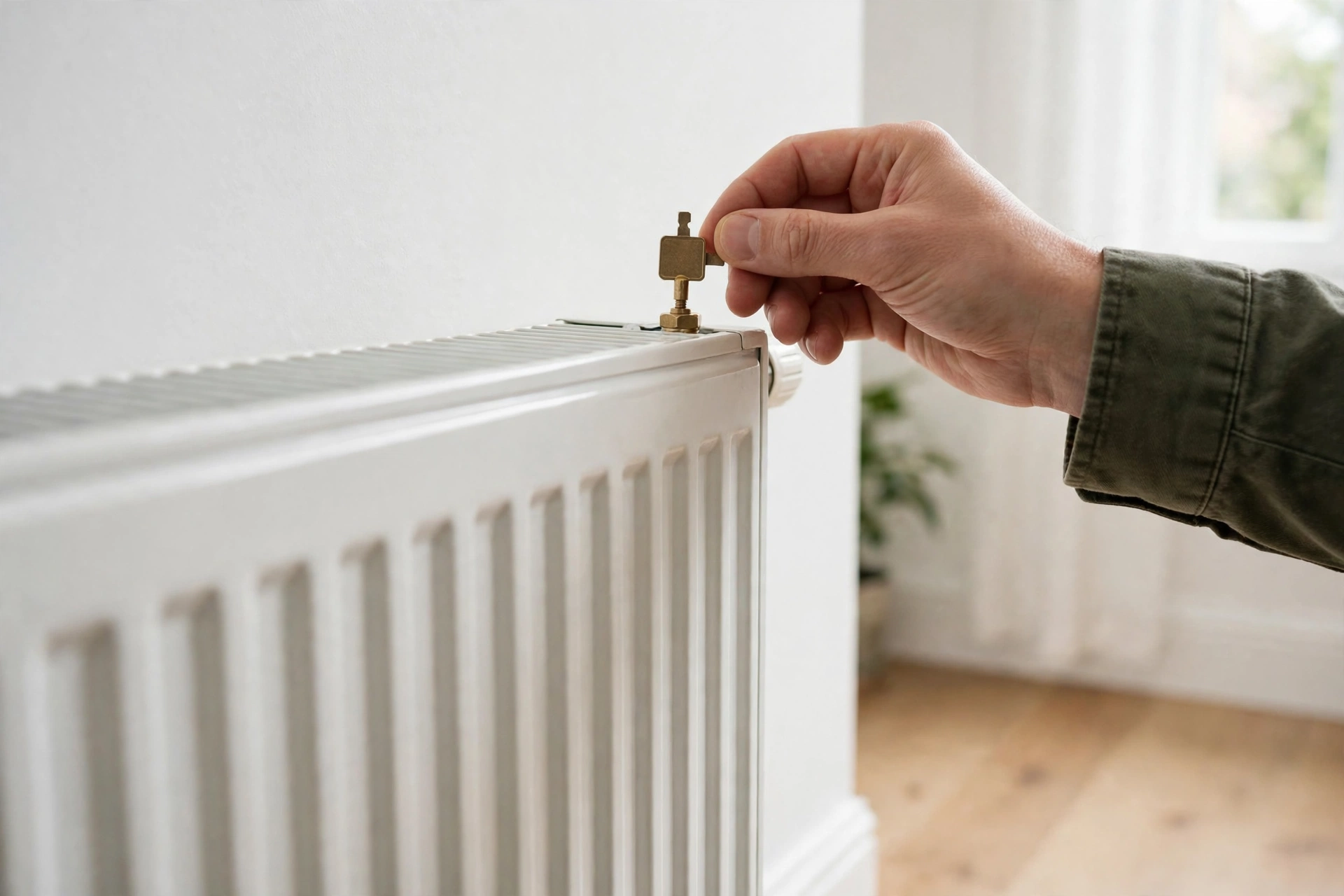
- At each radiator: hold the cloth under the bleed valve (the small square screw at the top corner, usually at the back), fit the key, and turn a quarter to half a turn anti-clockwise. You should hear a hiss — that’s the air escaping.
- Keep the valve open until the hiss stops and water starts to dribble steadily, then close it firmly — snug, not forced; overtightening damages the valve.
- Wipe the valve dry and check it again a minute later — a weeping bleed valve needs the system cold and the valve replaced, which is a small plumber job if you’re not confident.
- Sealed systems only — check the boiler pressure afterwards. Bleeding removes pressure as well as air. If the gauge has dropped below about 1 bar cold, top up via the filling loop to 1–1.5 bar cold, using the method in your boiler’s manual (manufacturers publish the exact steps for your model). Open vented systems (with a small header tank in the loft) refill themselves — no top-up needed.
- Turn the heating back on and listen. Test it worked: the gurgling should be gone, and the radiator that gurgled should now be hot evenly across the top — the cold-at-the-top patch was the air pocket.
If bleeding only helps for a week, then the noise is back
Air that keeps coming back is being made or let in — bleeding treats the symptom, not the cause. In rough order:
- Corrosion inside the system (most common). Steel radiators slowly corrode in heating water, and the reaction produces gas that collects exactly like air. The tell: the “air” you bleed may bring black water with it, or the problem returns every 1–3 weeks. The real fix is a system clean and fresh inhibitor — the same sludge story as Radiator Cold at the Bottom but Hot at the Top; a heating engineer can test the system water and dose it.
- A micro-leak letting air in. On a sealed system this usually shows as slowly dropping pressure too — if you’re also topping up often, work through Boiler Pressure Keeps Dropping before bleeding again; the two faults travel together.
- Pump drawing air in on older open-vented systems (air pulled down the vent pipe when the pump runs). This is an engineer diagnosis — don’t keep bleeding monthly and calling it maintenance.
If only one radiator gurgles
Bleed it first. If it gurgles less but still heats slowly, the radiator is probably being starved of flow by its lockshield valve (the capped valve at the opposite end from the handwheel/TRV) or by an unbalanced system where nearer radiators take all the flow:
- Note the lockshield’s current setting first: close it fully, counting the turns — write the number down so you can always return to it.
- Open it an extra half turn from its original setting and run the heating for an hour.
- If that radiator now heats properly and no other radiator has gone cold, leave it there. If you’ve robbed another radiator to feed this one, the system needs proper balancing — a methodical job an engineer does with thermometers, not guesswork. See One Room Always Cold for the full balancing method.
When it’s the pump — pro territory
The circulating pump pushes water around the whole system; when it struggles, the noise is a system-wide hum, vibration or whine rather than a gurgle in one radiator, and radiators furthest from the pump often go lukewarm. A homeowner can safely check only the obvious: is anything stored hard against the pump vibrating, and is the system pressure correct (low pressure makes pumps noisy and shortens their life)? Beyond that — pump speed settings, a seized pump, a replacement — is a heating engineer’s job: it involves the boiler’s wiring and sealed pipework. Rough UK orientation only: a replacement pump fitted is commonly in the £200–£400 range depending on model and region.
Common mistakes
- Bleeding with the heating on. With the pump running, opening a bleed valve can draw air in instead of letting it out, and the escaping water is hot enough to scald. Off and cooled down is slower by ten minutes and safer and more effective.
- Overtightening the bleed valve. Close it firmly — snug, not forced. Overtightening damages the valve and can leave it weeping.
- Bleeding in the wrong order. Air rises: do downstairs nearest the boiler first and upstairs last, or air you release downstairs is just replaced by air from upstairs.
- Forgetting the pressure top-up. On a sealed system, bleeding drops the pressure too. Below about 1 bar cold, top up to 1–1.5 bar via the filling loop — or the next fault you chase will be low pressure.
- Bleeding monthly and calling it maintenance. Noise back within 1–2 weeks, twice in a row, means the system is making gas or drawing air in — find the cause instead of bleeding again.
- Bleeding a kettling boiler. Rumbling from the boiler itself is limescale/sludge in the heat exchanger — a pro job, not a bleed job.
When to stop and call a pro
- Kettling/banging from the boiler itself — Gas Safe registered engineer (UK); never open the case
- Gurgling returns within 1–2 weeks of a correct bleed, twice in a row — the system is making gas or drawing air in
- Bleed valve snaps, rounds off, or won’t stop weeping after closing
- Pump-area humming/whining with radiators going lukewarm around the house
- Any gas smell — Gas Emergency line first (0800 111 999), then an engineer
Cost table
| Fix | Who does it | Typical cost |
|---|---|---|
| Bleed key | DIY | ~£1–£3 |
| Bleeding the house (correct order) | DIY | £0 beyond the key |
| Bleed valve replacement (if weeping/snapped) | Plumber | Small job; part + labour, quoted before the visit |
| System clean + inhibitor (recurring gas/sludge) | Heating engineer | Quoted per system; see Radiator Cold at the Bottom for powerflush range |
| Replacement pump, fitted | Heating engineer | Commonly £200–£400 |
US / UK term box
Reading from the US? The same physics applies to hydronic (hot-water) radiators and baseboards: gurgling means air in the loop, and bleeding at the radiator’s bleed valve is the same fix — US systems read pressure in psi (typical cold fill ~12 psi, roughly 0.8 bar) and often have automatic air vents that can fail shut. Lockshield = the radiator’s return-side balancing valve. Kitchen roll = paper towel. A Gas Safe engineer is the UK equivalent of a licensed heating contractor.
FAQs
Why does my radiator gurgle mostly when the heating first comes on?
Because that’s when the water starts moving. Overnight the air in the system settles at the highest points — the tops of radiators. When the pump starts, water has to force its way around those air pockets, and that squeezing-past is the gurgle. Once the system has run for a while the noise often fades, which is why it seems to “fix itself” until the next morning.
How often should I need to bleed a radiator?
Once at the start of the heating season is normal for many systems. Needing to bleed the same radiator every week or two is not — that’s the recurrence pattern in “If bleeding only helps for a week” above, and it points to corrosion gas or air being drawn in, not to a bleeding technique problem.
Should I bleed radiators with the heating on or off?
Off, and cooled down. With the pump running, opening a bleed valve can draw air in instead of letting it out, and the escaping water is hot enough to scald. Off-and-cool is slower by ten minutes and safer and more effective.
My radiator gurgles but it’s hot all over — is it still air?
Possibly a small pocket still moving through, or air elsewhere in the pipework passing that radiator. Bleed it once, correctly, and check the pressure afterwards. If a fully hot radiator keeps gurgling for days after a bleed, the sound is more likely flow noise or the pump — use the sound table at the top to re-triage rather than bleeding again.
Checklist
- Listen first: match the sound to the sound table before touching anything
- Heating off, radiators cooled down
- Bleed in order: downstairs nearest the boiler first, upstairs last
- Quarter to half a turn anti-clockwise; close when water dribbles steadily — snug, not forced
- Wipe the valve dry; re-check a minute later for weeping
- Sealed system: check the gauge — below ~1 bar cold, top up to 1–1.5 bar via the filling loop
- Heating on, listen: gurgling gone + evenly hot top = pass
- Noise back within 1–2 weeks, twice? Stop bleeding — check corrosion gas, micro-leak, pump
- One radiator only + slow to heat? Lockshield half-turn test, counting turns from the original setting
- Boiler kettling, pump whine, or any gas smell → pro / emergency line, not a bleed job
Related guides
- Heating pillar: https://faulttofix.com/heating/
- Radiator Cold at the Bottom but Hot at the Top — sludge pattern, when the bottom is cold: https://faulttofix.com/radiator-cold-at-bottom/
- One Radiator Not Working — stuck TRV pin, when one radiator is cold: https://faulttofix.com/one-radiator-not-working-trv-pin/
- Boiler Pressure Keeps Dropping — pressure that will not stay up: https://faulttofix.com/boiler-pressure-keeps-dropping/
- One Room Always Cold — balancing, when one room lags the rest: https://faulttofix.com/one-room-always-cold/
Sources line: bleeding order (nearest boiler/downstairs first, upstairs last), quarter-to-half-turn valve opening, and the top-up range (1–1.5 bar cold for UK sealed systems) are the standard homeowner guidance given by UK boiler manufacturers, labelled about/roughly in the text; the corrosion-gas recurrence mechanism and the 1–2 week recurrence window are described qualitatively, not as measured figures; pump replacement cost is labelled rough UK orientation only.